|
|
|
|
|
|
|
|
|
The
National Monument
Our
nation has a long, but largely unrecognized, history of courageous Americans
who have opposed U.S. aggression, violence, and war. The US Peace Memorial
Foundation honors Americans who stand for peace by (1) publishing the US Peace Registry, (2) awarding the
annual US Peace Prize, and (3) fundraising,
planning for, and constructing the US Peace Memorial in Washington, DC. The
first two projects are ongoing and well developed. It is time to advance and
fully develop the concept of the memorial as a permanent national monument engraved
with quotes from well-known Americans and equipped with electronic access to
information about the people and organizations we honor.
Although
it may take years to fund, design, and build the physical structure in our
nation’s capital, all elements currently exist in the 2021 book ENDING U.S. WARS by Honoring Americans Who Work for Peace and online at www.uspeacememorial.org/Quotes.htm, www.uspeaceprize.org, www.uspeacememorial.org/Registry.htm, and www.uspeacememorial.org/Organizations.htm. Until it is
constructed, the book is the US Peace Memorial.
The
monument will make it clear to our citizens that advocating for peaceful
solutions to international problems and opposing war are honorable endeavors. A
national monument to peacemakers can further raise awareness of these
activities and help to change our cultural mindset so that it will no longer be
acceptable to label those who speak out against war as un- American,
anti-military, disloyal, or unpatriotic.
Just
as you see military veterans at war monuments talking to young people, the US
Peace Memorial will serve a similar function of uniting generations. Once the
monument is built, it will be harder to disparage those who oppose war. When
criticized, a person could say, “Don’t you know there is a national monument
dedicated to people just like me?”
Children
are not taught about the U.S. peace movements that have existed at various
stages in our country’s development, our antiwar history, and the heroic
leaders. Most middle school and high school U.S. history texts neglect the
topic entirely. Once the monument is built, perhaps a photo will be included in
a textbook, later a paragraph, and eventually an entire chapter about working
for peace.
Before
beginning our project in 2005, we conducted an exhaustive online search for
peace memorials and monuments. The results were disappointing. In many U.S.
cities you will find “peace monuments” that are actually memorials to a war or
to the war dead. For example, the Perry’s Victory & International
Peace Memorial in Lake Erie, the Peace Monument on
the grounds of the Capitol that commemorates naval deaths during the Civil War,
and the Eternal Peace Flame in Gettysburg which commemorates a battle
and is surrounded by guns. Peace memorials in the U.S. tend to reinforce the
concept that “you earn the peace by winning the war.”
Although
several other countries have peace memorials that could serve as a model for
one in the United States, none are focused on the U.S. peace movement. The U.S.
has some as well, but all are local and not national monuments. These include
the Peace Memorial Park, Portland, OR; Peace Garden at Fresno State University,
CA; the Lyndale Park Peace Garden in Minneapolis, MN; the Peace Plaza in Salem,
OR; Peace Garden in Harrisburg, PA; Prairie Peace Park in Lincoln, NE; and The
Pacifist Memorial, Sherborn, MA. Also of note is the Dayton International Peace
Museum, in Dayton, OH.
Nothing
exists in the U.S. that could be considered a national peace memorial. There is
only one US Peace Memorial Foundation and only one plan to build a national
monument to recognize and honor those who have opposed U.S. war(s) and/or
proposed peaceful alternatives to war. The monument as it is envisioned will
have significant artistic merit that will honor and inspire the ideals of
peace. The US Peace Memorial will be a major piece of art that will attract
visitors for the beauty of its architecture as well as for its message. Much as
the structures of the Vietnam Veterans Memorial and the Martin Luther King Jr.
Memorial are effective in commemorating their respective histories, the quality
of the peace memorial’s unique configuration will bring national and
international attention to the broad spectrum of peace efforts by Americans and
U.S. organizations.
No
design decisions are likely until we have successfully completed the initial
fundraising campaign. At that point, there will be a nationwide call for ideas
and proposals. Our Founding Members will be consulted
about the physical design and will also be instrumental in considering the
options presented. Members are invited to submit ideas and sketches now, before
being involved in choosing the final architectural design.
Early
on, potential donors expressed interest in my thoughts about what the monument
might look like. Draft design A (below), drawn by James Knox, is a rough
concept of one possibility that emerged from my initial inspiration and
considerations.

Design A
(Concept by James Knox)
An
aerial view of this potential design would show a peace symbol surrounded by a
blue circle. Side views would reveal the twelve facets of the symbol. As one’s
eyes move skyward, the monument’s dimensions would gradually reduce in size to
form a spire. There could be space to walk through the structure where
additional quotations and electronic kiosks would be located.
When
the US Peace Memorial is built on the National Mall as planned, only officials
in government aircraft allowed to fly over the area will see the aerial view of
the peace symbol. That could be particularly effective in advocating for peace
to our elected officials who might not otherwise be reached so directly.
As
designed, the height at the peak would be 199 feet. By comparison, the
Washington Monument is 555.5 feet tall. The circle of the peace symbol has an
outside diameter of 150 feet and an inside diameter of 110 feet. The circular
walkway would be finished in deep blue ceramic or porcelain tile. Like the
Washington Monument, the Peace Memorial could have a white marble exterior and
an aluminum cap. However, to save resources and reduce maintenance, the
foundation is open to considering modern alternative materials such as
photocatalytic concrete. This self-cleaning technology may be considered due to
its property of removing contaminants and the effects of pollution.
Founding
Members have already submitted drawings based on
my
initial thoughts. Two are shown below.
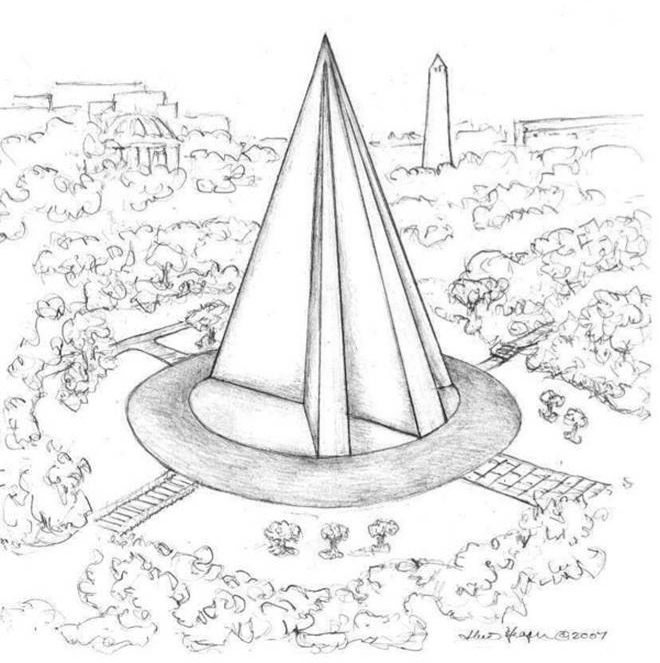
Illustration by
Alice Yeager
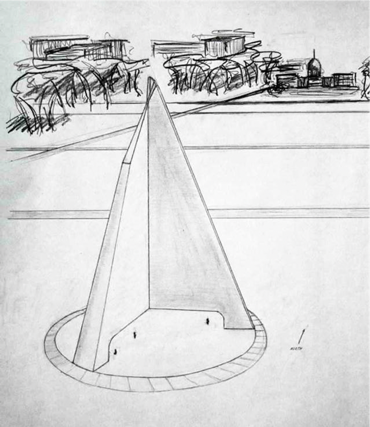
Illustration by
Beth Brookfield
Other
supporters, artists, engineers, and architects are encouraged to submit their
ideas. Below are two creative design ideas (B and C) contributed by James Knox.
Both concepts have plenty of surface area for honoring Americans who have
worked to end war. Hopefully these drawings will stimulate your creativity and
we will have a competition with many submissions.
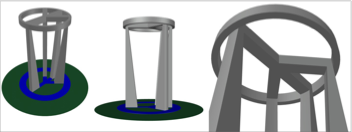
Design B
(Concept by James Knox)

Design C
(Concept by James Knox)
National
monuments are expensive to design, build, and maintain. More than twenty-five
years in the making, The Martin Luther King Jr. Memorial was finished in 2011.
It cost $120 million to build. The realization of the US Peace Memorial as a
physical structure will depend on how quickly sufficient donations are
received. At some point the Foundation will petition Congress to support
setting aside public land on the Washington Mall for construction. If efforts
to secure a location on the Mall fail, other sites and private land will be
considered. A highly visible site in the nation’s capital is deemed to be most
desirable.
NOTE: The envisioned design is costly and could
take years of fundraising to realize. Washington, DC also contains many smaller
memorials, often near street corners and away from the main tourist areas, many
of which are maintained by the National Park Service; others stand on private
property. Two examples that rely on extensive engraved text rather than a
single statue are the Japanese American Memorial to Patriotism During World War
II, near Union Station, whose granite walls are inscribed with internment camp
names and survivor quotations, and the African American Civil War Memorial on U
Street, whose Wall of Honor lists the names of 209,145 soldiers. While not the
ideal outcome, the Board of Directors could decide that a smaller, less
expensive memorial is the more practical path forward.
The
target date to begin construction has been arbitrarily set as July 4, 2034.
This is a very ambitious goal as progress is dependent on many factors
including gathering approvals, fundraising success, garnering public support,
final design, and completing numerous other activities. If the Peace Memorial
is to be built on the mall, the Foundation will need to secure approvals from
the National Capital Planning Commission, the Commission of Fine Arts, and the
National Capital Memorial Commission. But first, the Foundation must raise
millions of dollars to develop and build the monument and guarantee its
perpetual maintenance. We need to make the public aware of the project and to
recruit additional Founding Members.
The
Memorial will serve as a shared public symbol to remind all who visit— both
U.S. citizens and guests from around the world—that many Americans value peace.
Visiting the monument will be an educational experience, providing examples of
peace advocacy and antiwar actions. Ultimately, visitors will have the
opportunity to recognize, engage in, and internalize this important cultural
value so that it becomes reinforced as a part of our public consciousness and
discussion. The monument venue will provide teaching opportunities that could
help change U.S. culture and foreign policy by making us more aware of, and
more comfortable with, our rich history of antiwar activity and peace advocacy.
It will be dedicated to those who have opposed war or proposed peaceful
alternatives to U.S. aggression.
As
the US Peace Memorial is currently envisioned, twelve walls, or facets, will
contain engraved peace quotes from famous Americans such as Jane Addams,
Muhammad Ali, Albert Einstein, Benjamin Franklin, Ernest Hemingway, Helen
Keller, Martin Luther King Jr., and Margaret Mead, in addition to a variety of
U.S. presidents who are not widely known for their antiwar statements. We will
select strong, sometimes shocking, antiwar quotations that will surprise and
enlighten visitors and help them understand that it is socially acceptable to
speak out against war. Visitors will learn that American leaders from all walks
of life have opposed war.
The
first tier of quotations will be easily visible from ground level and will
include statements from Americans whose fame and thoughts are likely to stand
the test of time. Quotes from lesser-known figures may be displayed higher up
on the monument, where they could easily be viewed with a small telescope or
binoculars. Quotations currently under consideration are included on our
website at www.uspeacememorial.org/Quotes.htm, where they are fully
referenced. Digital projection mapping may be used to display quotes or other
media directly onto the monument, providing elements of movement and life. This
technology can be used to provide future enhancements and changes to the monument
that will encourage multiple visits.
Electronic
recognition kiosks will be strategically placed on and around the monument.
Using voice commands, the kiosks will have direct access to the US Peace
Registry and all data and links that it contains. The kiosks will also
display acknowledgements of the Founding Members at all levels, whose generous
philanthropy will make this project possible.
The
experience will be interactive. Imagine a grandmother taking her granddaughter
to explore Washington, DC. They step up to the monument and she says, “Let’s
see what grandma did for peace.” The grandmother states her name at the kiosk
and, when her information appears on the screen, she becomes an instant role
model for the young person. They can review antiwar activities together;
perhaps read articles and see videos of different actions in which the
grandmother was involved. This could become a formative experience that the
granddaughter will never forget. It could be the highlight of her trip to our
nation’s capital. And this scenario could be repeated many times a day as peace
proponents share the US Peace Memorial with their families and friends.
Alternate
methods such as a smartphone app could be used to interact with the monument as
a replacement for or to supplement in-place physical kiosks. This app and/or
the kiosks could additionally interface with projection mapping technology to
display material that the user is looking up and then present it on the
monument.
US Peace Memorial Foundation, Inc. is a tax-exempt 501(c)(3) public
charity.
Donations
to the Foundation are tax deductible to the extent provided by law.
Florida registration #: CH20094. A COPY OF THE OFFICIAL
REGISTRATION AND FINANCIAL INFORMATION MAY BE OBTAINED FROM THE FLORIDA
DIVISION OF CONSUMER SERVICES BY CALLING TOLL-FREE (800-435-7352) WITHIN THE
STATE. REGISTRATION DOES NOT IMPLY ENDORSEMENT, APPROVAL, OR RECOMMENDATION BY
THE STATE.
Copyright 2005-2026, US Peace Memorial Foundation, Inc.